
Nutritional Labeling
Kappa Labs provides in-house testing for all nutritional values required to produce an FDA ready food label.
Nutritional food labeling is a mandatory requirement for most processed and packaged food items. Labeling of meat, poultry, fish, and raw agricultural produce, including raw fruits and vegetables, are exempt from the mandatory label requirement, but may be voluntarily labeled.
Kappa Labs is an FDA registered, ISO 17025 accredited laboratory with over 35 years experience in microbial and chemical FDA food testing. We provide in-house testing for all nutritional values required to produce an FDA acceptable food label.
Important considerations in properly labeling food products are the Nutritional Facts Label, Ingredient Statement and Allergen Statement. The Food and Drug Administration reviews nutritional claims based on the label, the label being a legal document reflecting the stated values of the food item. Health claims are also reviewed and considered in light of present scientific and medical knowledge. The FDA has listed specific wording for label claims and values which the food item must contain in order to make a specific health claim.
Other items to consider are Shelf Life of the product and Statements of product identity, all of which should be accurate. Restaurants and food service providers have labeling requirements which differ from retail items in declaring nutritional content.
Nutrition Facts Label
Ingredient Statement
Allergen Statement
Food items known to possibly induce a Human Hypersensitivity reaction are termed Allergens. Allergens include milk, eggs, shellfish, tree nuts, peanuts, wheat (Gliadin), soybeans and sesame. The FDA requires specific Allergen labeling for most products with the exception of poultry, meats, certain egg products and alcoholic beverages.
New Label – 2020 Requirements
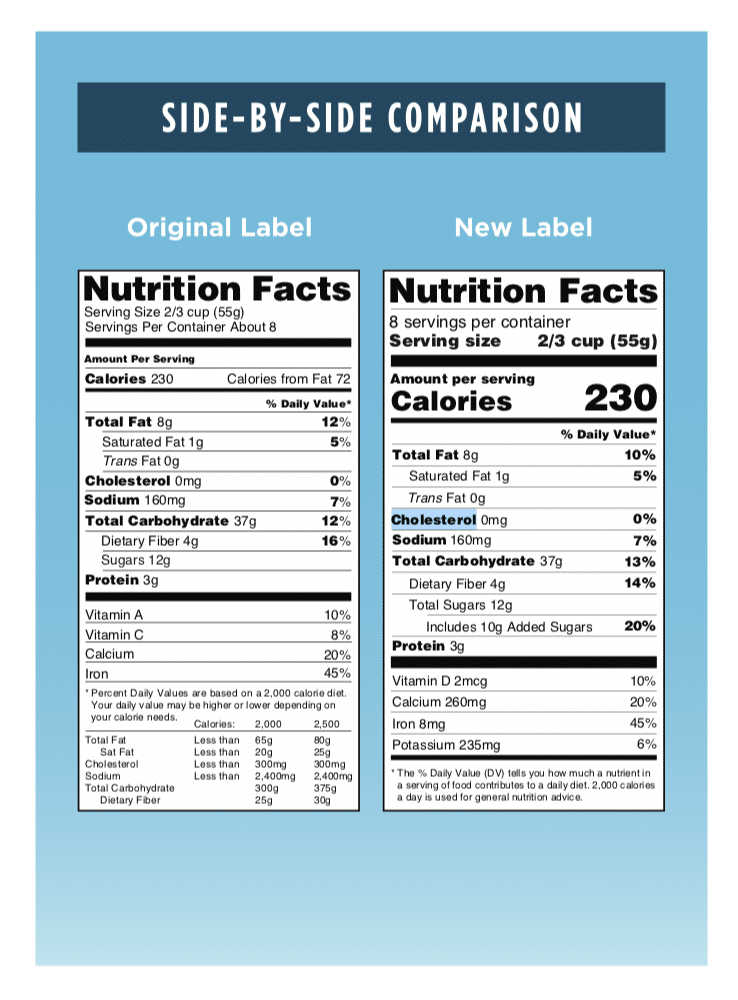
As a result of the FDA Nutrition Labeling and Education Act (NLEA), new mandatory nutrients have been added to food labels. Vitamin D, Potassium and Added Sugars have been added to the Nutritional Panel, while Vitamin E and Vitamin C are optional, but no longer mandatory.
What are the reasons for the changes? Since Vitamin D is so important for strong bones and the fact that it is common to have a Vitamin D deficiency in a typical diet, efforts are being made to help identify rich sources to ensure adequate dietary intake. Potassium, a necessary mineral for proper metabolic function has also been included to help identify sources rich in this essential electrolyte. Added Sugar has been included in the Panel in order to inform the consumer that this is being done by the producer and that the overall impact of this carbohydrate has been augmented.
We can see these changes in the side-by-side comparison of the old versus new label in the image provided by the FDA shown below.
Tests for Nutritional Label Content
The following tests are used to meet labeling requirements.
Calories
Total Fat
Saturated Fat
Trans Fat
Polyunsatured Fat
Monounsaturated Fat
Cholesterol
Sodium
Total Carbohydrates
Dietary Fiber
Total Sugars
Added Sugars
Protein
Vitamin D
Calcium
Iron
Potassium
Omega Fatty Acid Profile
Moisture
Ash
Nutritional Analysis
Nutritional content of a food item may also be determined by nutritional database calculation referring to the USDA database. Use of this approach requires very exact measurements of each ingredient by weight that is used to create the final food product. The nutritional content of each ingredient is calculated and a final nutritional content determined. This approach is applicable for simple food items, more complex foods must be analyzed in the laboratory.
Additional Nutritional Tests Available
Full Nutritional Supplement Label
Diet or Claim Specific Analyses
Vitamins: A, C, B1, B2, B6, B12, E, Folic Acid, Niacin
Minerals
How to Read a Nutritional Label
Many popular diets are based upon the knowledge that the body will metabolize the different food groups selectively. In order of utilization by the body the first to be utilized are simple sugars, which are rapidly broken down for energy. The second metabolic source will be complex sugars, which require initial breakdown by the digestive process. The third source is fats. This food type requires more extensive metabolism to cleave the fat chains and allow the body to utilize simpler carbon forms. The final source of energy is proteins, which are difficult for the body to break down, forcing utilization of other energy sources if available.
Calories and calories from fat give a rough estimation of the more readily utilized calories as opposed to fat, which may be stored as body fat if the body does not require the calories for immediate metabolic utilization. The percent daily value shows how much of each nutrient is required on a daily basis. Daily values are based upon 2,000 calories a day. In general, a diet of 1,000 to 1,500 calories a day is recommended for weight loss. These caloric amounts will differ between women and men. A person’s individual metabolic rate also comes into play.
Ingredients are listed in order from greatest to least. The ingredient which may be desired may be present in a small amount compared to other ingredients. Certain ingredients, such as trans fat, have been shown to be harmful and as a result are listed for the consumer awareness. “Partially hydrogenated” oils may also be associated with certain health risks.
To Get Started
Send an e-mail to the Kappa Labartories (info@kappalabs.com) or use the contact form below. Be sure to include with the following details.
- Description of the sample to be analyzed.
- Description of matrix to be analyzed.
- Determination of methods to be employed.
- Number of samples and number of analytes to be determined.